



Robinhood Reloads Stock Repurchase Plan to $1.5 Billion as Shares Continue in Downtrend
March 2026 · Capital Return Policy · Equity Markets
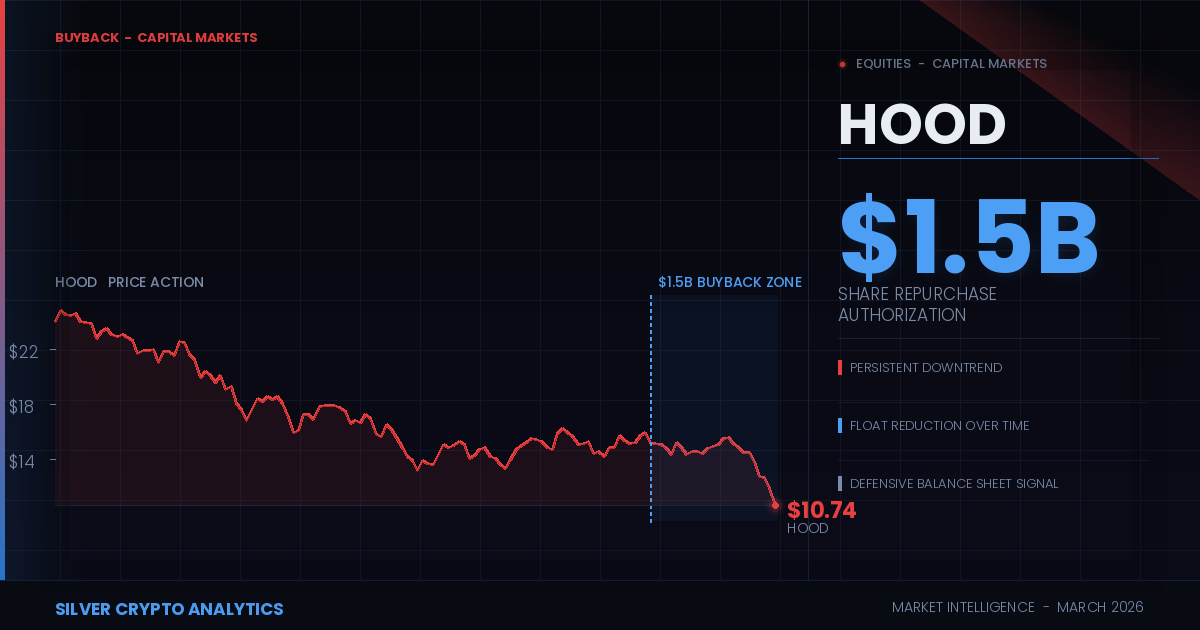
Robinhood has authorized an additional share repurchase program, increasing the capital allocation to $1.5 billion as its equity continues to trade in a persistent downtrend. The decision signals management's view that the current valuation is below intrinsic expectations, while also serving as a capital return mechanism amid weaker near-term market sentiment.
The buyback may provide tactical price support, but its broader impact will likely depend on whether investors interpret it as a confidence signal — or as a substitute for stronger organic growth.
$1.5B Repurchase Program Signals Management Confidence in Intrinsic Value
Robinhood has authorized an additional share repurchase program, increasing the capital allocation to $1.5 billion as its equity continues to trade in a persistent downtrend. The decision signals management's view that the current valuation is below intrinsic expectations, while also serving as a capital return mechanism amid weaker near-term market sentiment.
The renewed buyback authorization indicates a deliberate shift toward balance sheet-supported shareholder value preservation at a time when secondary market pricing remains under pressure. In institutional terms, repurchases of this scale can absorb incremental sell-side supply, reduce float over time, and potentially stabilize price action if execution is sustained across periods of elevated volatility.
Internal Capital Deployment Over External Expansion — A Structural Policy Choice
From a capital markets perspective, the move is notable because it suggests management is prioritizing internal capital deployment over external expansion at the margin. That typically reflects either confidence in forward cash generation or a lack of higher-return reinvestment opportunities, both of which carry implications for growth expectations and multiple compression.
For a platform business such as Robinhood, the repurchase also functions as a signal to longer-duration capital that current market pricing may be discounting the franchise's normalized earnings power.
In the broader market structure context, this is consistent with a defensive corporate response to weak equity momentum. Buybacks can improve per-share metrics mechanically, but they do not alter underlying revenue sensitivity to trading activity, interest rates, or retail market participation. As such, the transaction should be interpreted less as a cyclical inflection signal and more as a balance-sheet policy choice designed to mitigate valuation dislocation.
Execution Discipline and Funding Profile Will Determine Capital Efficiency Verdict
For institutional capital, the key variable is not the announcement itself but the pace, discipline, and funding profile of execution. If repurchases are funded from operating cash flow rather than leverage, the program may be viewed as a moderate positive for capital efficiency; if not, it could tighten financial flexibility during periods of softer trading volumes or margin compression.
Looking forward, the buyback may support medium-term price stability, but its broader impact on fund flows will likely depend on whether investors interpret it as a confidence signal or as a substitute for stronger organic growth.
In an environment where rates, liquidity conditions, and risk appetite remain decisive for platform valuations, the repurchase plan may provide tactical support, but it is unlikely to materially re-rate the stock without clearer evidence of durable operating acceleration.