



Solana Bets on AI Agents: Network Becoming Core Infrastructure for the 'Agentic' Internet
March 2026 · Solana Foundation · AI × Blockchain
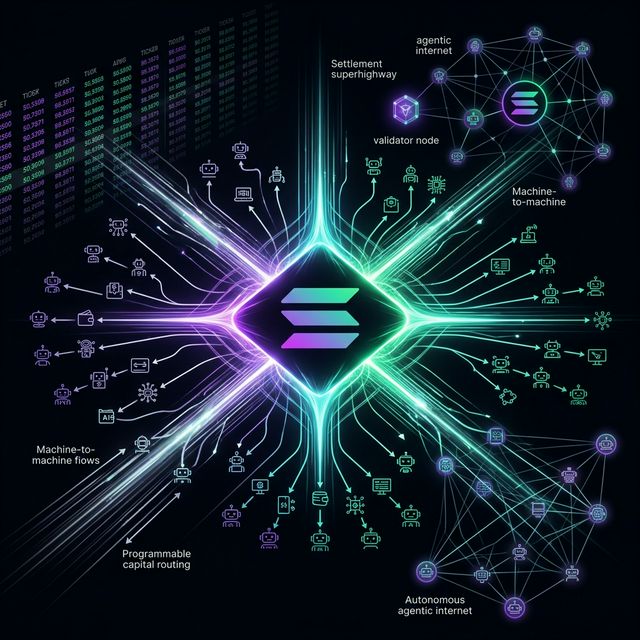
The Solana Foundation is positioning the network as a core settlement and coordination layer for emerging AI agent activity, framing the chain as infrastructure for an "agentic" internet.
The implication is less about speculative narrative and more about whether Solana can sustain the throughput, latency, and cost profile required for machine-to-machine economic activity at scale.
High-Velocity Settlement
Low latency and near-zero cost make Solana the natural rail for high-frequency agent microtransactions.
Machine-to-Machine Commerce
AI agents autonomously execute payments, access services, and route capital without human intervention.
Utility-Based Re-Rating
If agents generate durable fee revenue and throughput, network valuation shifts from sentiment to fundamentals.
Blockchain as the Invisible Backbone of the AI Economy
The Solana Foundation is positioning the network as a core settlement and coordination layer for emerging AI agent activity, framing the chain as infrastructure for an "agentic" internet. The implication is less about speculative narrative and more about whether Solana can sustain the throughput, latency, and cost profile required for machine-to-machine economic activity at scale.
From Retail Trading Venue to Machine-Economy Rail
The strategic message from Solana is that the network is being aligned with a broader structural shift in digital activity: autonomous software agents increasingly executing transactions, accessing services, and coordinating payments without direct human intervention.
In this context, blockchain infrastructure is evaluated not primarily as a retail trading venue but as a high-velocity settlement rail capable of supporting persistent microtransactions, identity-linked interactions, and programmable capital flows.
From a market structure perspective, Solana's relevance to AI agents depends on a combination of low transaction costs, high throughput, and operational reliability under sustained load. Networks unable to deliver consistent performance may see demand diverted toward chains with lower friction and stronger execution certainty.
For on-chain analysis, the key issue is whether AI-related activity can generate durable increases in active addresses, transaction count, fee revenue, and protocol-level stickiness. Even modest adoption can matter if it introduces a new class of non-human, high-frequency participants with repeated wallet interactions, service-to-service payments, and automated liquidity routing.
Utility Over Narrative: What Institutions Will Require
For institutional capital, this development is relevant insofar as it expands the addressable use case for Solana beyond consumer-facing applications and speculative activity. A credible role in AI agent infrastructure would support a longer-duration investment thesis centered on network utility, transaction demand, and platform optionality.
That said, institutions will require evidence of measurable adoption before assigning durable valuation premiums — particularly through sustained growth in fees, throughput, and application-level retention.
If AI-driven usage begins to meaningfully affect on-chain economics, it could strengthen the case for strategic allocation from funds seeking exposure to infrastructure beneficiaries of machine-driven digital commerce. The market will continue to discount claims not accompanied by observable data, especially in an environment where capital increasingly differentiates between narrative and verified usage.