



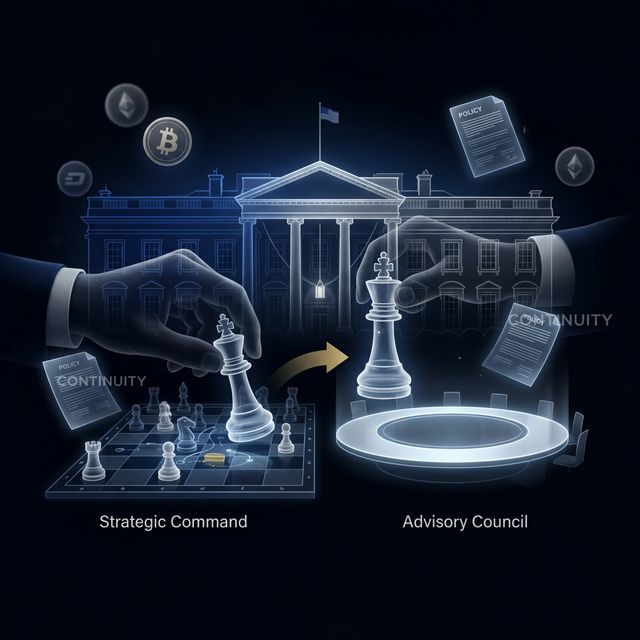
White House Crypto Czar David Sacks Transfers to Presidential Advisory Role
March 2026 · Digital Asset Policy · Administration Report
David Sacks has transitioned from his White House crypto czar position to a role on the President’s advisory committee, representing a procedural change in digital asset policy architecture.
The move preserves continuity in policy engagement while potentially reducing direct executive oversight over crypto-specific coordination.
Institutional Shift
Transition from operational czar role to consultative governance under the President's advisory committee.
Transmission Risk
Potential for increased latency in decision-making despite strategic continuity in the administration's agenda.
Continuity Signal
Preserves existing contact points for large allocators while shifting to a less embedded implementation framework.
Reconfiguring Digital Asset Policy Oversight
David Sacks has transitioned from his White House crypto czar position to a role on the President’s advisory committee, representing a procedural change in the administration’s digital asset policy architecture rather than a shift in stated policy direction. The move preserves continuity in policy engagement while potentially reducing the degree of direct executive oversight over crypto-specific coordination.
Shift from Implementation to Consultative Governance
The transfer of David Sacks should be interpreted as an institutional reconfiguration of policy influence. For markets, the primary variable is the extent to which this alters the velocity, coordination, and prioritization of crypto-related regulatory initiatives.
This transition signals a move toward consultative governance, which can reduce immediacy in policy execution where interagency alignment is required. Market participants may infer a slightly lower probability of near-term policy acceleration, even if the strategic agenda remains intact.
A shift toward an advisory framework introduces additional latency in decision-making, which can affect sectors dependent on institutional adoption and compliant capital formation. The broader ecosystem may price in altered expectations around licensing and enforcement posture.
Managing Execution & Regulatory Risk
For institutional capital, the principal implication is policy execution risk. Large allocators prefer stable, centralized points of contact when evaluating custody models and treasury exposure.
If the advisory structure limits agency coordination, it may introduce incremental uncertainty for firms deploying capital into tokenized assets and stablecoins.
Looking ahead, significance depends on whether the administration continues to prioritize a coherent framework. If not, it could contribute to a slower policy cadence, favoring a wait-and-see posture among institutional participants.